The Netherlands is hiring workers from all over the world through work permit visas. If you’re interested in working abroad, this could be a great opportunity.
In 2026, a large number of workers have already received entry permits, and many companies will offer job opportunities even without prior experience.
This is especially good news for Bangladeshis, as the Netherlands has finally approved the work permit visa, something many people have been waiting for a long time.
At present, no worker can enter the Netherlands without a valid work permit visa. However, with this visa, you can enter at a low cost within approximately 90 days.
Usually, the Netherlands follows a 90-day entry process for work permit visas. In some cases, it may take a little longer, but the government is currently giving special focus to work visas.
Why Choose the Netherlands in 2026? (Interesting Facts to Know!)
Before we dive into the complexities of the MVV and IND portals, let’s look at some fascinating facts that make the Netherlands a top-tier destination for Bangladeshi professionals:
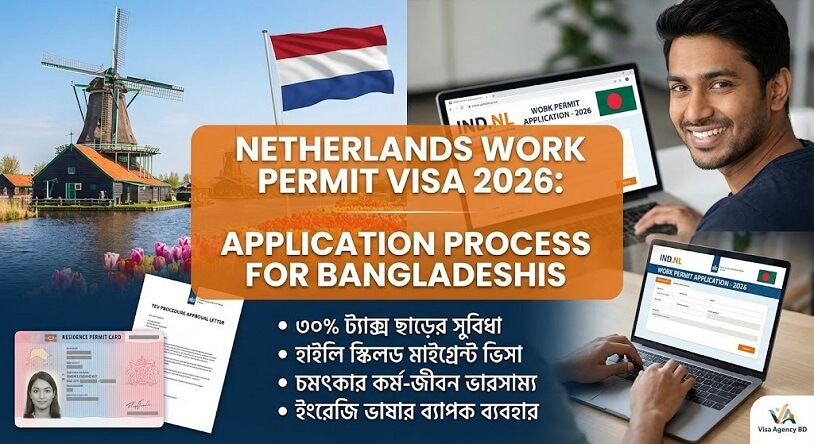
- The Famous 30% Tax Ruling: The Netherlands offers a massive financial incentive for highly skilled migrants. If you meet the criteria, you can receive up to 30% of your gross salary completely tax-free for up to 5 years, allowing you to save a huge portion of your income!
- English is Everywhere: While learning Dutch is helpful for integration, the Netherlands has the highest English proficiency of any non-native English-speaking country in the world. You can easily navigate corporate jobs, supermarkets, and government offices using only English.
- The Four-Day Work Week: Dutch work culture highly values personal time. It is incredibly common for professionals to negotiate a 32-hour (four-day) work week, giving you ample time to explore Europe or spend time with your family.
- World-Class Infrastructure: The country is famous for its flat landscape and cycling culture. With more bicycles than people and an immaculate public train system, commuting in the Netherlands is highly efficient, clean, and stress-free.
MAJOR 2026 UPDATES: What Bangladeshi Applicants Must Know
If you are planning to apply for a Dutch work permit in 2026, you must understand the latest financial and legal requirements set by the IND. The Dutch government has raised the bar to ensure that foreign workers are paid fairly and are not exploited by unauthorized agencies.
Here are the critical 2026 updates you need to know:
1. Increased Minimum Salary Thresholds
To qualify for a work permit in the Netherlands, your Dutch employer must pay you a minimum gross monthly salary (excluding the mandatory 8% holiday allowance). Effective January 1, 2026, the IND has increased these thresholds by approximately 4.5% to align with EU standards:
- Highly Skilled Migrants (30 years and older): Must earn at least €5,942 per month.
- Highly Skilled Migrants (under 30 years): Must earn at least €4,357 per month.
- Reduced Criterion (e.g., recent graduates from top universities): Must earn at least €3,122 per month.
- EU Blue Card Holders: Must earn at least €5,942 per month (or €4,754 for qualifying recent graduates).
2. Stricter Employer Compliance and Record-Keeping
The IND is strictly cracking down on payroll and staffing agencies that act as middlemen. The prohibition on staffing agencies sponsoring highly skilled migrants persists, meaning you must be hired directly by the company you will work for. Additionally, starting in 2026, sponsors must retain absolute proof (like bank statements) that your salary was paid directly into a bank account in your name.
3. Digital Processing and Faster Approvals
The IND portal has significantly enhanced its digital submission capabilities. If your employer is a “Recognized Sponsor,” your application can be bundled and processed digitally in just 2 to 4 weeks, compared to the standard 90-day waiting period.
Top Netherlands Work Visas for Bangladeshi Citizens
Depending on your qualifications and the type of job you secure, you will apply under one of these primary permit categories:
1. The Highly Skilled Migrant Permit (Kennismigrant)
This is the most popular and streamlined visa for Bangladeshi IT professionals, engineers, and executives.
- The Rule: You must have a job offer from an employer who is officially registered with the IND as a Recognized Sponsor.
- The Advantage: If your salary meets the 2026 thresholds (€4,357 or €5,942 depending on your age), the employer is completely exempt from conducting a labor market test (meaning they do not have to prove they couldn’t find a Dutch or EU citizen for the job).
2. The EU Blue Card
Similar to the Highly Skilled Migrant permit, the EU Blue Card is designed for highly educated employees.
- The Rule: You must possess a recognized higher education degree and earn at least €5,942 per month.
- The Advantage: The Blue Card makes it easier to move to another European Union country later, as the time spent in the Netherlands counts toward your long-term EU residency.
3. The Single Permit (GVVA – Work + Residence Permit)
If your job does not meet the Highly Skilled Migrant salary thresholds, or your employer is not a Recognized Sponsor, you must apply for the GVVA.
- The Rule: This is a combined residence and work permit. However, it is much harder to get because the Employee Insurance Agency (UWV) must conduct a strict labor market test. Your employer must prove that they advertised the job for at least 5 weeks to 3 months and could not find anyone in the Netherlands or the European Economic Area (EEA) to do the work.
Recommended: Sweden Work Permit Visa.
The Step-by-Step Application Process from Bangladesh
The Dutch immigration process is unique because it is primarily an employer-driven process. You cannot apply for a work permit on your own; your employer must initiate it. Here is the exact roadmap:
Step 1: Secure a Job with a Recognized Sponsor
You must apply for jobs online from Bangladesh using platforms like LinkedIn, Indeed NL, or specialized tech recruitment boards. Ensure the company making the offer is listed on the IND’s Public Register of Recognized Sponsors.
Step 2: The Employer Applies for the TEV Procedure
Once you sign your employment contract (which must state your 2026 salary), your employer submits an application to the IND in the Netherlands. They will apply for the TEV procedure (Entry and Residence Procedure), which combines the application for your MVV (Provisional Residence Permit) and your final Residence Permit.
Step 3: Wait for IND Approval
If your employer is a Recognized Sponsor, the IND usually makes a decision within 2 to 4 weeks. For standard Single Permits (GVVA), the decision period can legally take up to 90 days, as the UWV must verify the labor market test.
Step 4: IND Issues the Approval Letter
Once approved, the IND will send a positive decision letter to your employer. This letter explicitly states that you are now authorized to collect your MVV visa sticker.
Step 5: Book an Appointment at the Dutch Embassy in Dhaka
You must collect your MVV visa sticker in person. In Bangladesh, you do not go to VFS Global for the MVV sticker; instead, you must make a direct appointment at the Embassy of the Kingdom of the Netherlands in Dhaka by sending an email to dha-ca@minbuza.nl. You must do this within 3 weeks of the positive decision date.
Step 6: Attend Your Embassy Appointment
On the day of your appointment, you must bring your valid Bangladeshi passport, your passport-sized photographs, and the completed application form. A staff member at the embassy will register your application and take your biometric data (your fingerprints and a digital signature).
Step 7: Collect the MVV and Travel
The embassy will stamp the MVV visa sticker into your passport. This sticker is valid for 90 days and allows you to enter the Netherlands.
Step 8: Register in the Netherlands
Upon arriving in the Netherlands, you must register your address at the local municipality (Gemeente) to receive your BSN (Citizen Service Number). You will then collect your physical Residence Permit card from a designated IND desk.
Complete Document Checklist for Bangladeshi Applicants
Missing documents or improper translations can delay your application by weeks. Ensure you have the following ready:
- Valid Bangladeshi Passport: Must be valid for at least 6 months beyond your intended date of arrival.
- Employment Contract: A legally binding contract signed by you and your Dutch employer, clearly proving you meet the 2026 salary requirements (e.g., €4,357 or €5,942).
- Completed Application Forms: Duly filled and signed.
- Educational Certificates: Digital copies of your university degrees, diplomas, and transcripts. If requested, these must be translated into Dutch, English, French, or German, and officially legalized.
- Clean Criminal Record: You must sign an antecedents certificate declaring you have no criminal history.
- Photographs: Recent European passport-sized color photographs that meet Dutch specifications.
(Note: The IND may request additional proof of your qualifications or your employer’s financial stability during the process.)
Visa Processing Costs and Fees in 2026
Moving to Europe requires careful financial planning. Fortunately, in the Netherlands, the employer usually pays the hefty immigration fees, but it is important to know the costs involved:
- IND Application Fee: The standard application fee for a Highly Skilled Migrant permit, Intra-Corporate Transfer (ICT) permit, EU Blue Card, or Single Permit (GVVA) is €423.
- Dependent Family Fees: If you are bringing your spouse or partner, the IND fee is €254 per application. For each minor child, the fee is €85.
- Employer Recognition Fee: If your employer is applying to become a Recognized Sponsor for the first time, they must pay the IND a regular fee of €5,080 (or a reduced fee of €2,539 for smaller companies/startups).